
Indian chicken and lamb samosas are triangular pastries filled with cooked minced chicken and lamb, ginger, garlic, green chilli, cumin, coriander, onions and fresh herbs. They are folded in thin samosa pastry, sealed with flour paste and fried until crisp and golden.
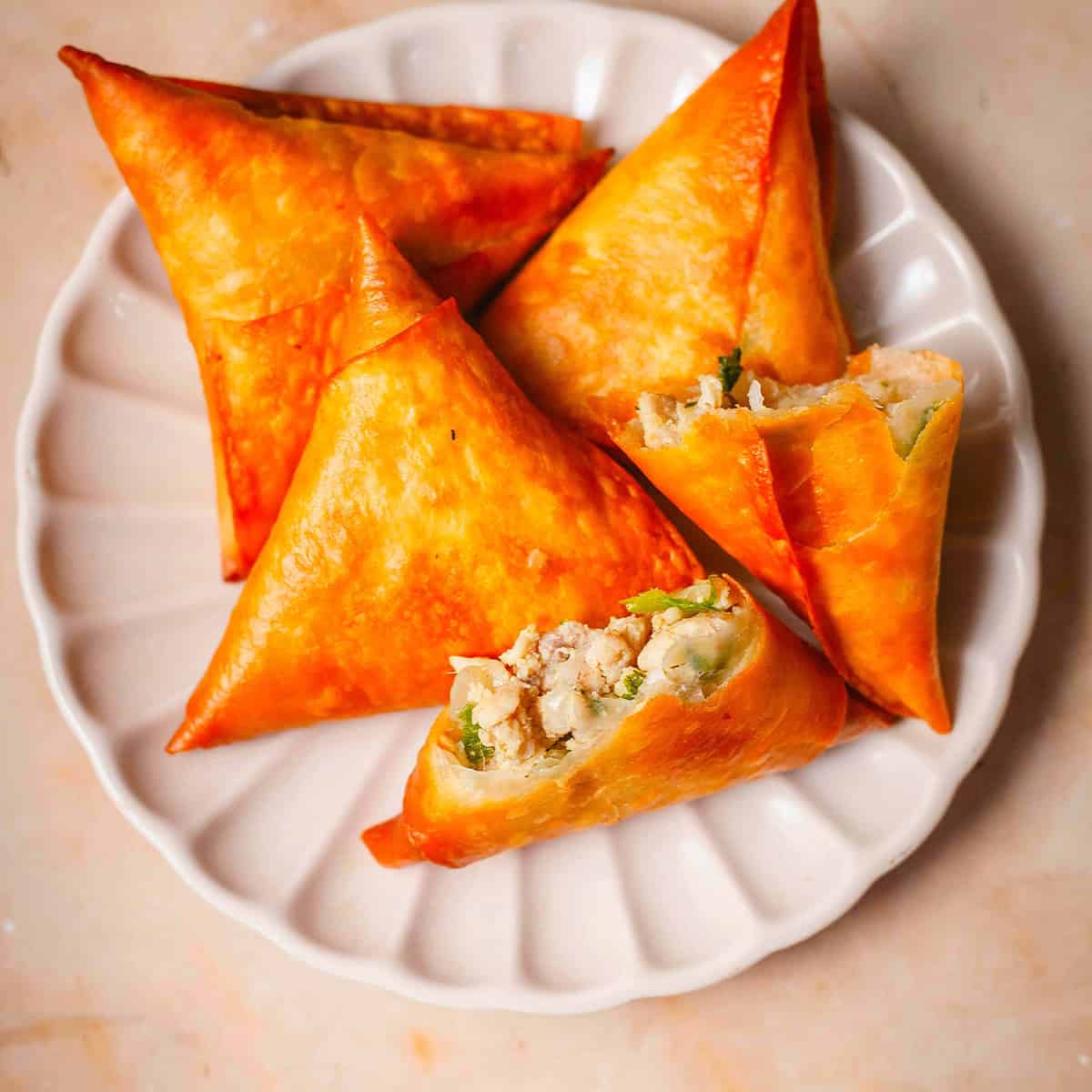
A month or two before Ramadan, many Muslim families start making samosas in preparation for the month ahead. It's an annual tradition in our family too. My mum makes them, my mother-in-law makes them, and we all follow much the same method. We set aside time to prepare a big batch, fold them by hand and freeze them so there are plenty ready for iftar.
We use both chicken and lamb because my mother-in-law, who has years of professional experience making samosas, believes the combination gives the best flavour. She's made these for a living, so I'm happy to take her word for it!
Jump to:
- A little about samosas
- Making our family samosas
- The trick to crispy samosas
- Recipe Snapshot
- Why You'll Love These Samosas
- Ingredient Notes
- How to Make Indian Chicken and Lamb Samosas
- Serving Suggestions
- Tips for Making the Best Samosas
- Variations
- Storage and Freezing
- Frequently Asked Questions
- 📖 Recipe
- Serving Suggestions
- Tips for Making the Best Samosas
- Variations
- Storage and Freezing
- Frequently Asked Questions
A little about samosas
Samosas are a familiar sight across the Muslim world, particularly during Ramadan. You'll find different versions in Somalia, Zanzibar and Oman, where they are often known as sambuus or samboosa. There are also plenty of variations within India itself. Punjabi samosas, for example, are particularly well known and are often larger, with thicker pastry and generous fillings.
Making our family samosas
The filling is cooked until all the moisture has evaporated, then cooled completely before being mixed with finely diced onion, fresh coriander and spring onions. We use thin samosa pastry leaves, fold each one by hand and seal it with a simple flour paste.
Once they're all made, we test a few by frying them before flash-freezing the rest individually. This gives us a chance to check the seasoning and make sure the filling is just right before putting the batch away.
The trick to crispy samosas
One of our favourite techniques is to start frying the samosas in cold oil, allowing the oil to come up to temperature while they cook. This produces particularly crisp, golden pastry and is the method we use at home.
It's a little bit of preparation upfront, but having homemade samosas ready for Ramadan makes it worthwhile.
Recipe Snapshot
Cuisine: Indian
Course: Snack, appetiser
Preparation Time: 1 hour 30 minutes
Cooking Time: 45 minutes (in batches)
Total Time: Approximately 2 hours 15 minutes
Makes: 70-90 samosas
Main Ingredients: Chicken mince, lamb mince, samosa pastry, onions, ginger, garlic and fresh coriander
Cooking Method: Deep frying
Why You'll Love These Samosas
- A flavourful meat filling: Chicken and lamb mince together give the filling a lovely depth of flavour.
- A family recipe: My mum and mother-in-law both make their samosas this way. My mother-in-law also has years of professional experience making them.
- Ideal for Ramadan: Make a large batch ahead of time, freeze them individually and fry as many as you need.
- Fresh herbs and spices: Ginger, garlic, green chilli, cumin, coriander and spring onions give the filling plenty of flavour.
- Crisp pastry: Starting the samosas in cold oil allows the temperature to rise gradually as they cook, helping create a lovely crisp finish.
Ingredient Notes
- Chicken and lamb mince: We use a combination of chicken and lamb mince, 1kg in total. My mother-in-law, who has professional experience making samosas, prefers this combination because she finds it gives the best flavour.
- Onions: Finely dice the onions and squeeze out their excess liquid using muslin cloth. They are added after the mince has cooled.
- Ginger: Crushed ginger gives the filling a lovely aromatic flavour.
- Garlic: Freshly crushed garlic works particularly well with the meat and spices.
- Green chilli paste: Adds flavour and heat throughout the filling. Adjust the quantity to suit your preference.
- Ground cumin: Brings warmth and an earthy flavour to the mince.
- Ground coriander: Adds a gentle citrusy note and complements the cumin.
- Fresh coriander: Use a generous bunch. It adds freshness and is an important part of the filling.
- Spring onions: These add a little sweetness and freshness. Slice them finely so they distribute evenly.
- Samosa pastry leaves: These are thin, ready-made rectangular pastry sheets, available from Asian supermarkets and grocery shops. Keep them covered while assembling to prevent them drying out.
- Ghee and oil: Ghee adds flavour. You can use a combination of ghee and neutral oil or oil alone.
- Plain flour: Mixed with water, this creates the paste used to seal the samosas.
How to Make Indian Chicken and Lamb Samosas
Cook the mince
Place the chicken and lamb mince in a large, heavy-based pan over medium heat.
Break the mince apart with a wooden spoon and cook until it begins to brown. As it cooks, the meat will release moisture.
Once the water starts to evaporate, add the crushed ginger, garlic, green chilli paste, ground cumin, ground coriander and salt.
Mix everything together thoroughly and continue cooking, breaking up any larger pieces of mince as you go.
Cook until the mince is completely cooked through and all the moisture has evaporated. The filling should be fairly dry, with no liquid collecting at the bottom of the pan.
Remove from the heat and leave to cool completely.
Prepare the onions and herbs
Place the finely diced onions in a piece of muslin cloth.
Gather the edges and squeeze firmly to remove as much onion liquid as possible. This is important because excess moisture can make the filling wet.
Once the mince is completely cool, add the strained onions, chopped fresh coriander and sliced spring onions.
Mix everything together until evenly distributed. Taste and adjust the seasoning if needed.
Make the flour paste
Add the plain flour and water to a small bowl.
Mix until you have a smooth, thick paste without any lumps.
This is the glue that will seal the samosas and hold the pastry together.
You may need to top up the paste as you work, so keep a little extra flour and water nearby.
Fold the samosas
Take one samosa pastry leaf and lay it flat on your work surface with the long side facing you.
The pastry should be a long rectangular strip.
Fold one bottom corner diagonally across the strip to form a triangle. Open the folded section gently to create a pocket.
Place a spoonful of the cooled mince filling inside. Avoid overfilling, as this makes the samosa harder to fold and seal.
Fold the triangle upwards, keeping the filling enclosed. Continue folding the triangle over itself, alternating from one side to the other, until you reach the end of the pastry strip.
You should now have a neat triangular parcel.
Brush the remaining pastry flap with a little flour paste and fold it over to seal. Press gently to secure it.
Repeat with the remaining pastry leaves and filling.
A folding tip: Keep the edges aligned as you fold and make sure the filling is completely enclosed. A well-sealed samosa is much less likely to open during frying.
Test a few samosas
Before freezing the entire batch, we like to fry a few samosas first.
This gives us a chance to check the seasoning, filling and pastry, and make sure we're happy with the finished result.
If needed, adjust the seasoning of the remaining filling before continuing with the batch.
Fry or freeze
At this stage, you can either fry the samosas to serve straight away or prepare the rest for Ramadan.
To fry:
One of our favourite ways to fry samosas is to start them in cold oil. Rather than dropping them into hot oil, arrange a batch in a wide, deep pan and cover with cold oil. Make sure they have enough room and aren't overcrowded.
Place the pan over medium-low heat and allow the oil to come up to temperature gradually while the samosas cook.
As the oil heats, the pastry cooks gently and begins to crisp. Turn the samosas carefully when needed so they colour evenly.
Continue frying until the pastry is crisp and golden and the filling is piping hot throughout.
Remove with a slotted spoon and place on a wire rack or kitchen paper to drain.
Note - Starting with cold oil and allowing the temperature to rise gradually is the technique we use for particularly crisp samosas.
To freeze:
This is how we prepare our samosas ahead of Ramadan.
Arrange the uncooked, assembled samosas in a single layer on baking trays lined with baking paper or plastic bags.
Place the trays in the freezer until the samosas are completely firm.
Once frozen, transfer the samosas into freezer bags or airtight containers and return them to the freezer.
Note - Freezing them individually first means they won't stick together, so you can easily remove just as many as you need.
Serving Suggestions
Serve these chicken and lamb samosas hot with ketchup (if you are new here, please note that i hate ketchup and i would never willingly consume it), mint and coriander raita, tamarind chutney or a green chilli chutney.
They are particularly lovely as part of an iftar spread alongside dates, corn chaat, chicken kebabs, aloo tikki chaat, aloo pakoras and other savoury snacks.
A cup of masala chai alongside them is always welcome too.
Tips for Making the Best Samosas
- Cool the mince completely: Warm filling can soften the pastry and make folding difficult.
- Remove excess onion liquid: Squeezing the onions through muslin helps keep the filling dry.
- Keep the pastry covered: Samosa leaves dry out quickly when exposed to air. Keep unused sheets covered with a clean, slightly damp tea towel.
- Don't overfill: A little filling goes a long way. Overfilled samosas are harder to seal and more likely to split.
- Seal properly: Use enough flour paste to secure the final flap, but avoid making the pastry too wet.
- Test before freezing: Fry a few samosas to check the seasoning and pastry before freezing the rest.
- Freeze in a single layer: Flash-freezing prevents the samosas from sticking together in the freezer.
- Start with cold oil: Allowing the oil temperature to rise gradually while the samosas cook helps achieve a crisp, golden pastry.
Variations
Add red chilli: If you prefer a hotter filling, add red chilli powder or finely chopped fresh red chillies alongside the other spices.
Add garam masala: A teaspoon of garam masala gives the mince a deeper, warmer flavour. Add it towards the end of cooking.
Adjust the meat: You can change the ratio of chicken to lamb, although our preferred combination is both together.
Make them spicier: Increase the green chilli paste to suit your taste.
Storage and Freezing
- Freezing uncooked samosas: Arrange the assembled samosas in a single layer on a lined baking tray. Freeze until firm, then transfer to freezer bags or airtight containers. Return to the freezer.
- How long do they keep? For best quality, use frozen uncooked samosas within 2-3 months.
- Cooking from frozen: We fry ours from frozen using our cold-oil method. Allow the oil to warm gradually and cook over a moderate heat until the pastry is golden and the filling is piping hot throughout.
- Storing cooked samosas: Allow cooked samosas to cool completely, then refrigerate in an airtight container for up to 3 days. Reheat in an oven or air fryer until crisp and piping hot.
Frequently Asked Questions
Can I make samosas ahead of time?
Absolutely. In fact, this is how we make ours. Many Muslim families prepare samosas a month or two before Ramadan, flash-freezing them individually and storing them in freezer bags. You can then fry as many as you need.
Why do you use chicken and lamb mince together?
We find that the combination gives the best flavour. It's my mother-in-law's preferred way of making meat samosas, based on her years of professional experience making them.
Why do you add the onions after cooking the mince?
We add the onions once the mince has cooled because we want them to retain their fresh texture. Squeezing them through muslin first also removes excess liquid, which helps prevent a soggy filling.
Can I add garam masala to the filling?
Yes. Add around 1 teaspoon of garam masala towards the end of cooking if you prefer a more deeply spiced filling. You can also add red chilli powder for extra heat.
Why do you flash-freeze samosas?
Flash-freezing allows the samosas to freeze individually before being packed away. This prevents them sticking together, making it easy to take out exactly how many you need.
Why do you start frying samosas in cold oil?
Starting with cold oil allows the temperature to rise gradually while the samosas cook. We find this gives particularly crisp, golden pastry. It is important to keep the heat moderate and allow the samosas enough time to cook through.
Can I fry samosas straight from frozen?
Yes. We fry ours directly from frozen using our cold-oil method. Allow the oil temperature to rise gradually and cook until the pastry is golden and crisp and the filling is piping hot throughout.
What are samosas called in Somalia?
In Somalia, samosas are commonly known as sambuus. They are a popular savoury snack, particularly during Ramadan. Similar filled pastries are enjoyed in Zanzibar and Oman, where they are also known by regional names such as sambusa and samboosa.
Are Punjabi samosas different from other Indian samosas?
Punjabi samosas are one of the best-known Indian varieties. They are often larger, with a thicker pastry and generous fillings, traditionally including spiced potatoes and peas, although meat versions also exist. Indian samosas vary considerably by region, family and filling.
How many samosas does this recipe make?
This recipe makes approximately 70-90 samosas, depending on the size of your pastry strips and how much filling you use in each one.
Can I use just chicken or lamb mince?
Yes. You can use either on its own, but we prefer the combination of both for flavour.
More indian Ramadan recipes:


Did you make this recipe?
Rate and Leave a comment
i'd love to hear about it! did you try any variations? if you loved this recipe/tried any variations/have some top tips, please leave a star rating and comment below. Your reviews make our day and your tips help others to find our recipes and enjoy them too!
you can also follow us on instagram and subscribe to our newsletter to get our latest recipes.
📖 Recipe

Indian Chicken and Lamb Mince Samosas
Ingredients
For the mince filling
- 1 kg chicken and lamb mince combined
- 2 large onions finely diced
- 1 tablespoon crushed ginger
- 1 tablespoon crushed garlic
- 1 tablespoon green chilli paste
- 2 teaspoon ground cumin
- 1 teaspoon ground coriander
- 1 large bunch fresh coriander finely chopped
- 2 - 3 spring onions finely sliced
- 1 teaspoon salt or to taste
For assembling
- 70 - 90 samosa pastry leaves
For the flour paste
- 35 g plain flour
- 50 ml water
For frying
- Neutral cooking oil enough for deep frying
Instructions
Cook the mince
- Place the chicken and lamb mince in a large, heavy-based pan over medium heat.
- Break the mince apart with a wooden spoon and cook until it begins to brown. As it cooks, the meat will release moisture.
- Once the water starts to evaporate, add the crushed ginger, garlic, green chilli paste, ground cumin, ground coriander and salt.
- Mix everything together thoroughly and continue cooking, breaking up any larger pieces of mince as you go.
- Cook until the mince is completely cooked through and all the moisture has evaporated. The filling should be fairly dry, with no liquid collecting at the bottom of the pan.
- Remove from the heat and leave to cool completely.
Prepare the onions and herbs
- Place the finely diced onions in a piece of muslin cloth.
- Gather the edges and squeeze firmly to remove as much onion liquid as possible. This is important because excess moisture can make the filling wet.
- Once the mince is completely cool, add the strained onions, chopped fresh coriander and sliced spring onions.
- Mix everything together until evenly distributed.
- Taste and adjust the seasoning if needed.
Make the flour paste
- Add the plain flour and water to a small bowl.
- Mix until you have a smooth, thick paste without any lumps.
- This is the glue that will seal the samosas and hold the pastry together.
- You may need to top up the paste as you work, so keep a little extra flour and water nearby.
Fold the samosas
- Take one samosa pastry leaf and lay it flat on your work surface with the long side facing you.
- The pastry should be a long rectangular strip.
- Fold one bottom corner diagonally across the strip to form a triangle. Open the folded section gently to create a pocket.
- Place a spoonful of the cooled mince filling inside. Avoid overfilling, as this makes the samosa harder to fold and seal.
- Fold the triangle upwards, keeping the filling enclosed. Continue folding the triangle over itself, alternating from one side to the other, until you reach the end of the pastry strip.
- You should now have a neat triangular parcel.
- Brush the remaining pastry flap with a little flour paste and fold it over to seal. Press gently to secure it.
- Repeat with the remaining pastry leaves and filling.
A folding tip: Keep the edges aligned as you fold and make sure the filling is completely enclosed. A well-sealed samosa is much less likely to open during frying.
Test a few samosas
- Before freezing the entire batch, we like to fry a few samosas first.
- This gives us a chance to check the seasoning, filling and pastry, and make sure we're happy with the finished result.
- If needed, adjust the seasoning of the remaining filling before continuing with the batch.
Fry or freeze
- At this stage, you can either fry the samosas to serve straight away or prepare the rest for Ramadan.
To fry:
- One of our favourite ways to fry samosas is to start them in cold oil. Rather than dropping them into hot oil, arrange a batch in a wide, deep pan and cover with cold oil. Make sure they have enough room and aren't overcrowded.
- Place the pan over medium-low heat and allow the oil to come up to temperature gradually while the samosas cook.
- As the oil heats, the pastry cooks gently and begins to crisp. Turn the samosas carefully when needed so they colour evenly.
- Continue frying until the pastry is crisp and golden and the filling is piping hot throughout.
- Remove with a slotted spoon and place on a wire rack or kitchen paper to drain.
- Starting with cold oil and allowing the temperature to rise gradually is the technique we use for particularly crisp samosas.
To freeze:
- This is how we prepare our samosas ahead of Ramadan.
- Arrange the uncooked, assembled samosas in a single layer on baking trays lined with baking paper.
- Place the trays in the freezer until the samosas are completely firm.
- Once frozen, transfer them into freezer bags or airtight containers and return them to the freezer.
- Freezing them individually first means they won't stick together, so you can easily remove just as many as you need.
Notes
Nutrition Disclaimer
Nutritional information is provided as an estimate only. Not all ingredients may be included in the nutritional calculation, and the amount of oil absorbed by the samosas during frying can vary. For this reason, the actual nutritional values, particularly calories and fat, may differ from those shown.Serving Suggestions
Serve these chicken and lamb samosas hot with ketchup (if you are new here, please note that i hate ketchup and i would never willingly consume it), mint and coriander raita, tamarind chutney or a green chilli chutney. They are particularly lovely as part of an iftar spread alongside dates, corn chaat, chicken kebabs, aloo tikki chaat, aloo pakoras and other savoury snacks. A cup of masala chai alongside them is always welcome too.
Tips for Making the Best Samosas
- Cool the mince completely: Warm filling can soften the pastry and make folding difficult.
- Remove excess onion liquid: Squeezing the onions through muslin helps keep the filling dry.
- Keep the pastry covered: Samosa leaves dry out quickly when exposed to air. Keep unused sheets covered with a clean, slightly damp tea towel.
- Don't overfill: A little filling goes a long way. Overfilled samosas are harder to seal and more likely to split.
- Seal properly: Use enough flour paste to secure the final flap, but avoid making the pastry too wet.
- Test before freezing: Fry a few samosas to check the seasoning and pastry before freezing the rest.
- Freeze in a single layer: Flash-freezing prevents the samosas from sticking together in the freezer.
- Start with cold oil: Allowing the oil temperature to rise gradually while the samosas cook helps achieve a crisp, golden pastry.
Variations
Add red chilli: If you prefer a hotter filling, add red chilli powder or finely chopped fresh red chillies alongside the other spices.
Add garam masala: A teaspoon of garam masala gives the mince a deeper, warmer flavour. Add it towards the end of cooking.
Adjust the meat: You can change the ratio of chicken to lamb, although our preferred combination is both together.
Make them spicier: Increase the green chilli paste to suit your taste.
Storage and Freezing
- Freezing uncooked samosas: Arrange the assembled samosas in a single layer on a lined baking tray. Freeze until firm, then transfer to freezer bags or airtight containers. Return to the freezer.
- How long do they keep? For best quality, use frozen uncooked samosas within 2-3 months.
- Cooking from frozen: We fry ours from frozen using our cold-oil method. Allow the oil to warm gradually and cook over a moderate heat until the pastry is golden and the filling is piping hot throughout.
- Storing cooked samosas: Allow cooked samosas to cool completely, then refrigerate in an airtight container for up to 3 days. Reheat in an oven or air fryer until crisp and piping hot.


Leave a Reply