
Crisp, buttery kataifi pastry, a creamy mozzarella and double cream filling, pistachios and a lemony orange blossom syrup. This is my take on knafeh, with ground cardamom running through the syrup and cheese filling for a little extra warmth.
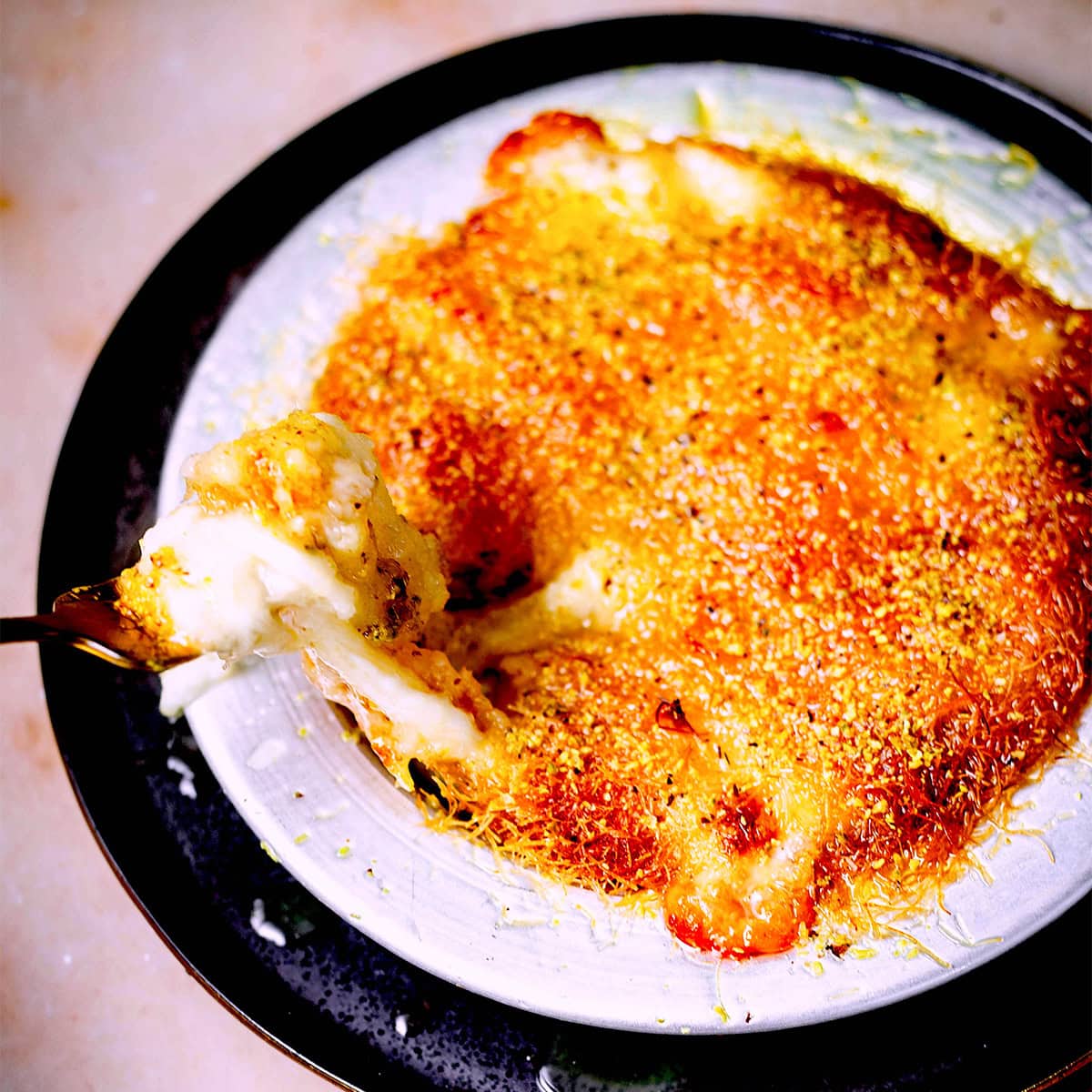
There are quite a few ways to make knafeh, and the spelling changes depending on where you are too. You might see kunafa, kanafeh, knafeh, knafe or künefe. This version is a home-style cheese knafeh made with mozzarella and cream, rather than trying to replicate one particular regional version.
The butter and oven do all the work. It is traditional to add Red or orange food colouring to the shredded pastry but you can leave it out if you prefer.
Jump to:
Recipe Snapshot
Prep time: 20 minutes
Cook time: 40-50 minutes
Total time: 1 hour 10 minutes
Serves: 10-12
Course: Dessert
Cuisine: Middle Eastern
Diet: Vegetarian
What is Knafeh?
Knafeh is a pastry dessert made with fine strands of kataifi pastry, a sweet syrup and a filling that varies considerably between versions.
Cheese versions are particularly well known, with regional recipes using cheeses such as Nabulsi or Akkawi. Other versions use cream-based fillings.
The version I'm making here sits somewhere in that home-cooking territory. I use mozzarella with double cream to create a soft, stretchy filling that is easy to make with ingredients you can actually find in a UK supermarket.
The finished knafeh is crisp on the outside, creamy in the middle and soaked with just enough fragrant syrup to bring everything together.
A Little Knafeh History
Knafeh has a much longer history than the bright orange cheese dessert many of us recognise today.
One of the earliest recorded recipes associated with knafeh appears in the Kitab al-Tabikh, a 13th-century Arabic cookery book from Baghdad. That version was quite different from today's familiar cheese-filled dessert, using thin pieces of pastry with butter or oil, sugar and nuts.
The cheese-filled forms developed later. The knafeh associated with Nablus in Palestine became particularly famous, traditionally using Nabulsi cheese and developing into the style that many people picture when they hear the word knafeh.
From there, the dessert travelled and changed. Different communities developed their own versions, with variations in the pastry, filling, cheese, syrup and toppings.
So when you see kunafa, kanafeh, knafeh or künefe, you're not necessarily looking at exactly the same dessert. They're part of a much wider family of pastries that have travelled, adapted and been made differently from one kitchen to another.
Why You'll Love This Knafeh
It is properly crisp - The kataifi gets coated in melted butter before baking, giving you those golden crunchy strands.
The filling stays creamy - Mozzarella gives you the familiar stretchy cheese texture while double cream makes the filling softer and richer.
Cardamom and orange blossom change the whole thing - The original structure of knafeh stays intact, but the syrup has a warm citrus-floral flavour rather than simply being sweet.
It looks far more complicated than it is - Once the kataifi is prepared, it's basically a case of layering, baking and pouring over syrup.
Ingredients
For the Syrup
Sugar - Caster sugar works well here.
Water - Enough to create a pourable syrup without making it excessively thick.
Orange blossom water - This gives the syrup its floral citrus flavour. I prefer orange blossom in this version because it works particularly well with the cardamom and pistachio.
Lemon juice - The acidity balances the sweetness and stops the syrup tasting flat.
Ground Cardamom - This is where the warmth comes in. You don't need much. Ground cardamom is enough to perfume the syrup without turning it into a cardamom dessert.
For the Knafeh
Kataifi pastry - Kataifi is the fine shredded pastry used for knafeh. Keep it covered while you're working because it dries out quickly.
Butter - use Salted butter if possible. This gets worked through the kataifi so every strand is coated.
Mozzarella - Use the one that comes in a ball shape. It gives you that stretchy cheese filling and is more creamy than cheesy.
Food Colouring - Orange or Red, Optional
Double cream - The cream is mixed directly with the mozzarella. It isn't a separate cream layer. It softens the cheese and makes the filling richer.
Ground Cardamom - A little more cardamom goes into the filling itself, so the flavour isn't only coming from the syrup.
Pistachios, crushed - Some can go into the filling and the rest over the top.
Dried rose petals, optional - These are purely for finishing. They add colour and a gentle floral note.
How to Make Knafeh
1. Make the syrup
Add the sugar, water and lemon juice to a saucepan.
Bring to a boil, then reduce the heat and simmer for around 10 minutes until you have a clear, fairly runny syrup.
Remove from the heat and stir in the orange blossom water and ground cardamom.
Set aside to cool to room temperature.
You want the syrup cool or at room temperature when it goes onto the hot knafeh.
2. Prepare the filling
Shred or finely chop the mozzarella.
Mix it with the double cream and ground cardamom until evenly combined.
Set aside while you prepare the pastry.
3. Prepare the kataifi
If your kataifi is frozen, thaw it according to the packet instructions.
Cut or break the kataifi into shorter strands. You can use your hands or kitchen scissors. Even better, use a food processor.
Pour over the melted butter, food colouring and orange blossom water if using. Now use your hands to massage the butter through the pastry.
Take your time here. You want the strands evenly coated.
4. Assemble
Grease 2 x 20cm baking tins.
Take roughly half of the buttered kataifi and press a quarter firmly into the base of one tin. Repeat with the other. A flat-bottomed glass or cup works well for this.
Make sure the base is evenly covered, particularly around the edges.
Spread over the mozzarella and cream mixture evenly over both tins.
Scatter around 25g of the crushed pistachios over both fillings.
Cover with the remaining kataifi and press down gently.
You want the top compact enough to hold together but don't squash it into a solid block.
5. Bake
Heat the oven to 180°C / 160°C Fan / Gas Mark 4.
Bake for 40-50 minutes, until the knafeh is deeply golden and crisp.
Don't take them out when it is pale golden. The deeper colour gives you the flavour and crunch you're after.
6. Add the syrup
Take the hot knafeh out of the oven.
Pour roughly ¾ of the cooled syrup evenly over the hot pastry.
Let it sit for about 10 minutes so the syrup can absorb.
You can add more syrup afterwards if you prefer it sweeter, but you may not need all of it.
7. Finish
Carefully invert both knafeh dished onto a serving plate if you want the golden underside facing upwards. You can also serve it straight from the tin.
Scatter over the remaining pistachios and, if using, dried rose petals. Serve warm.
What Makes This Knafeh Different?
Mozzarella Instead of Traditional Knafeh Cheese
Traditional cheese knafeh can use cheeses such as Nabulsi or Akkawi, but they are not always easy to find in UK supermarkets.
I use mozzarella as a practical alternative because it melts well and gives you that stretchy cheese texture.
It is not the traditional cheese for knafeh. It is simply a readily available cheese that works particularly well in a home kitchen.
Double Cream in the Cheese Filling
The double cream is mixed directly with the mozzarella rather than being used as a separate cream layer.
It softens the cheese and makes the filling richer and creamier. It also means you don't need to make a separate cream filling, which keeps the recipe fairly straightforward.
A Little Cardamom
Cardamom does quite a bit here despite the small quantity.
There is ground cardamom in both the syrup and filling, giving the knafeh a gentle warmth that works particularly well with orange blossom and pistachio.
I wouldn't dramatically increase the amount. Cardamom can take over very quickly, and you still want the cheese, butter and pastry to taste like knafeh.
Why I Don't Recommend Filo
Filo and kataifi are related pastries, but they behave differently.
Knafeh relies on those fine strands of kataifi to create its distinctive crisp texture. If you use filo, you'll end up with something much closer to a baklava-style dessert.
For this recipe, stick with kataifi.
Tips for Crisp Knafeh
The biggest thing is not drowning the knafeh in syrup.
Start with around three-quarters of the syrup and give it time to absorb. You can always add more.
The kataifi also needs to be properly golden before you remove it from the oven. Pale pastry won't give you the same crisp texture.
Make sure the butter is evenly worked through the kataifi too. Dry patches of pastry will not brown in the same way.
How to Serve Knafeh
Serve warm with extra crushed pistachios and, if you like, a few dried rose petals.
Acup of strong tea or Arabic coffee works well.
And if you want to go all in, add a scoop of vanilla ice cream.
Can I Make Knafeh Ahead?
You can assemble the knafeh shortly before baking, but I prefer baking it close to serving time. The pastry is at its best when freshly baked and crisp.
The syrup can be made a day or two ahead and kept covered in the fridge. Bring it back towards room temperature before using it.
Can I Freeze Knafeh?
Knafeh is best freshly baked, but leftovers can be refrigerated and reheated.
Reheat it in the oven rather than the microwave if you want to bring some of the crispness back.
Knafeh, Kunafa or Kanafeh?
You'll find this dessert written as:
Knafeh
Kunafa
Kanafeh
Knafe
Künefe
The spelling varies according to language and region.
For this recipe, I'm using knafeh, but if you've always called it kunafa, we're talking about the same broad family of dessert.
Frequently Asked Questions
Is Knafeh the Same as Kunafa?
Knafeh and kunafa are different spellings used for a family of Middle Eastern pastries. Recipes vary considerably between countries and regions.
Is Mozzarella Traditional in Knafeh?
Mozzarella isn't the traditional cheese associated with Nabulsi knafeh. It is used here because it is widely available and gives a good stretchy, melty filling.
What Is Kataifi?
Kataifi is a very fine shredded pastry. It looks a little like thin strands of noodles and is used in desserts across the region.
Why Is My Knafeh Not Crispy?
It may need more time in the oven. Knafeh should be deeply golden before you take it out.
Too much syrup can also soften the pastry, so start with around three-quarters of the syrup and add more if needed.
Can I Use Rose Water Instead of Orange Blossom?
Yes. Use the same quantity, but remember that rose water has a stronger flavour, so it can become quite noticeable.
More Middle Eastern-Inspired Desserts
If you like the combination of crisp pastry, nuts and floral flavours, you might also like:
Turkish Chocolate Pistachio Baklava
Baklava Cake with Honey Nut Topping & Citrus Cardamom Syrup
Cold Milk Baklava (Soguk Baklava)
Chocolate Pistachio Microwave Kataif Cake - B Laban inspired
Rate and Leave a comment
Did you make this recipe? i'd love to hear about it! did you try any variations? if you loved this recipe/tried any variations/have some top tips, please leave a star rating and comment below. Your reviews make our day and your tips help others to find our recipes and enjoy them too!
you can also follow us on instagram and subscribe to our newsletter to get our latest recipes.
📖 Recipe
Knafeh with Cardamom, Orange Blossom & Pistachio
Ingredients
For the Syrup
- 500 g Caster Sugar
- 300 ml Water
- 1 teaspoon Orange Blossom Water
- Squeeze Lemon Juice
- ½ teaspoon Ground Cardamom
For the Knafeh
- 450 g Kataifi Pastry
- 225 g Butter Melted
- Few drops Orange Food colouring Optional
- ½ - 1 teaspoon Rose Water or Orange Blossom Water Optional
- 600 g Mozzarella ball
- 175 ml Double Cream
- ½ teaspoon Ground Cardamom
- 75 g Crushed Pistachios
- 2 tablespoon Dry Rose Petals for garnish, optional
Instructions
Make the syrup
- Add the sugar, water and lemon juice to a saucepan.Bring to a boil, then reduce the heat and simmer for around 10 minutes until you have a clear, fairly runny syrup.Remove from the heat and stir in the orange blossom water and ground cardamom.Set aside to cool to room temperature.You want the syrup cool or at room temperature when it goes onto the hot knafeh.
Prepare the Filling
- Shred or finely chop the mozzarella.Mix it with the double cream and ground cardamom until evenly combined.Set aside while you prepare the pastry.
Prepare the kataifi
- If your kataifi is frozen, thaw it according to the packet instructions.Cut or break the kataifi into shorter strands. You can use your hands or kitchen scissors. Or even better a food processor. Pour over the melted butter, food colouring and orange blossom water if using. Now use your hands to massage the butter through the pastry.Take your time here. You want the strands evenly coated.
Assemble
- Grease 2 x 20cm baking tins.Take roughly half of the buttered kataifi and press a quarter firmly into the base of one tin. Repeat with the other. A flat-bottomed glass or cup works well for this.Make sure the base is evenly covered, particularly around the edges.Spread over the mozzarella and cream mixture evenly over both tins.Scatter around 25g of the crushed pistachios over both fillings.Cover with the remaining kataifi and press down gently.You want the top compact enough to hold together but don't squash it into a solid block.
Bake
- Heat the oven to 180°C / 160°C Fan / Gas Mark 4.Bake for 40–50 minutes, until the knafeh is deeply golden and crisp.Don't take them out when it is pale golden. The deeper colour gives you the flavour and crunch you're after.
Add the syrup
- Take the hot knafeh out of the oven.Pour roughly ¾ of the cooled syrup evenly over the hot pastry.Let it sit for about 10 minutes so the syrup can absorb.You can add more syrup afterwards if you prefer it sweeter, but you may not need all of it.
Finish
- Carefully invert both knafeh dished onto a serving plate if you want the golden underside facing upwards. You can also serve it straight from the tin.Scatter over the remaining pistachios and, if using, dried rose petals. Serve warm.
Notes
What Makes This Knafeh Different?
Mozzarella Instead of Traditional Knafeh Cheese Traditional cheese knafeh can use cheeses such as Nabulsi or Akkawi, but they are not always easy to find in UK supermarkets. I use mozzarella as a practical alternative because it melts well and gives you that stretchy cheese texture.It is not the traditional cheese for knafeh. It is simply a readily available cheese that works particularly well in a home kitchen. Double Cream in the Cheese Filling The double cream is mixed directly with the mozzarella rather than being used as a separate cream layer. It softens the cheese and makes the filling richer and creamier. It also means you don't need to make a separate cream filling, which keeps the recipe fairly straightforward. A Little Cardamom Cardamom does quite a bit here despite the small quantity. There is ground cardamom in both the syrup and filling, giving the knafeh a gentle warmth that works particularly well with orange blossom and pistachio. I wouldn't dramatically increase the amount. Cardamom can take over very quickly, and you still want the cheese, butter and pastry to taste like knafeh. Why I Don't Recommend Filo Filo and kataifi are related pastries, but they behave differently. Knafeh relies on those fine strands of kataifi to create its distinctive crisp texture. If you use filo, you'll end up with something much closer to a baklava-style dessert. For this recipe, stick with kataifi.
Tips for Crisp Knafeh
The biggest thing is not drowning the knafeh in syrup. Start with around three-quarters of the syrup and give it time to absorb. You can always add more. The kataifi also needs to be properly golden before you remove it from the oven. Pale pastry won't give you the same crisp texture. Make sure the butter is evenly worked through the kataifi too. Dry patches of pastry will not brown in the same way.How to Serve Knafeh
Serve warm with extra crushed pistachios and, if you like, a few dried rose petals. A cup of strong tea or Arabic coffee works well. And if you want to go all in, add a scoop of vanilla ice cream.Can I Make Knafeh Ahead?
You can assemble the knafeh shortly before baking, but I prefer baking it close to serving time. The pastry is at its best when freshly baked and crisp. The syrup can be made a day or two ahead and kept covered in the fridge. Bring it back towards room temperature before using it.Can I Freeze Knafeh?
Knafeh is best freshly baked, but leftovers can be refrigerated and reheated. Reheat it in the oven rather than the microwave if you want to bring some of the crispness back.Knafeh, Kunafa or Kanafeh?
You'll find this dessert written as: KnafehKunafa
Kanafeh
Knafe
Künefe The spelling varies according to language and region. For this recipe, I'm using knafeh, but if you've always called it kunafa, we're talking about the same broad family of dessert.
Frequently Asked Questions
Is Knafeh the Same as Kunafa?
Knafeh and kunafa are different spellings used for a family of Middle Eastern pastries. Recipes vary considerably between countries and regions.Is Mozzarella Traditional in Knafeh?
Mozzarella isn't the traditional cheese associated with Nabulsi knafeh. It is used here because it is widely available and gives a good stretchy, melty filling.What Is Kataifi?
Kataifi is a very fine shredded pastry. It looks a little like thin strands of noodles and is used in desserts across the region.Why Is My Knafeh Not Crispy?
It may need more time in the oven. Knafeh should be deeply golden before you take it out.Too much syrup can also soften the pastry, so start with around three-quarters of the syrup and add more if needed.
Leave a Reply